
Homeowners usually reach for a concrete cleaner without knowing what actually caused the stain, so they end up guessing which product will work. That guess matters, because oil, rust, red clay, and algae are chemically unrelated problems that happen to look similar from a distance.
Oil needs to be broken down or absorbed. Rust needs an acid to dissolve the iron oxide. Algae and mold need to be killed, not rinsed away. One cleaner cannot do all three, no matter what the label claims.
This guide is organized by stain type, not by product. Identify what you are dealing with first, then use the right chemistry for it.
Why Concrete Stains Behave Differently in the First Place
Concrete is porous. Depending on the mix and finish, it has a network of microscopic pores that absorb liquids rather than letting them sit on the surface. This is why concrete looks dry within an hour of rain but why a stain from three years ago is still visible.
Once a contaminant penetrates below the surface, cleaning is no longer just about washing something off. It becomes about either breaking the chemical bond holding the contaminant in the pores or breaking the contaminant down into something that rinses away. Different contaminants require different chemistry to do that. This is the entire reason no single “best” cleaner exists.
Oil and Grease Stains
Oil stains come from vehicle leaks, dropped fasteners on garage floors, cooking grease near patios, or lawn equipment. Fresh stains behave very differently from old ones.
Fresh oil sits mostly on the surface and has not fully penetrated. An absorbent material (cat litter, baking soda, or a commercial absorbent) applied within hours can pull a meaningful amount out before it sets, followed by a degreaser for the residue.
Set oil stains have penetrated into the pores and require a degreaser with dwell time, not just a rinse. Alkaline degreasers break the oil’s molecular structure so it can be flushed out. Enzymatic and bio-based degreasers use bacteria or enzymes that consume the hydrocarbons, which works well but takes longer, often multiple days for older stains.
Realistic expectations: oil that has been sitting for years, especially in a garage where it never gets rained on and flushed, may lighten significantly but not disappear completely without repeated treatment or mechanical abrasion. Anyone claiming a spray-on product will fully erase a decade-old oil stain in one application is overselling.
Rust Stains
Rust on concrete typically comes from metal furniture, fertilizer with iron content, irrigation systems using well water high in iron, or rusting rebar near the surface.
Rust is iron oxide, and iron oxide does not respond to degreasers or bleach. It requires an acid to dissolve chemically. Oxalic acid is the most effective option for homeowner-level rust removal, applied diluted, given several minutes of dwell time, then scrubbed and rinsed. White vinegar works on lighter, fresher stains through the same acidic mechanism but is considerably weaker and may need repeated applications, and frequent use can etch the surface slightly over time.
A common mistake: using a degreaser or bleach-based cleaner on a rust stain. Neither addresses the iron oxide chemistry, so the stain remains unchanged no matter how long it sits or how hard you scrub.
Red Clay Stains
This deserves more attention than most concrete cleaning guides give it, because it is one of the most misunderstood stains and one of the most common across the Southeast, including Upstate South Carolina.
Red clay is not ordinary dirt. It contains a high concentration of iron oxide, the same compound responsible for rust. When wet clay contacts concrete, it forms a fine paste that penetrates the pores. As it dries, the iron oxide bonds chemically with the concrete itself, not just settling on top of it.
Here is the part most homeowners get wrong: pressure washing can make red clay staining worse. High-pressure water removes loose surface clay but can also drive the remaining iron-rich particles deeper into the pores, embedding the stain further. This is why a driveway pressure washed regularly with plain water sometimes shows a slowly darkening, permanent orange-red discoloration over the years, even though it “looks cleaner” right after each wash.
Removing set red clay staining requires a product formulated specifically to dissolve iron oxide, typically a buffered acid cleaner designed to break the bond without aggressively etching the concrete surface. The process is chemistry first, mechanical rinsing second: apply the cleaner, allow it to dwell (commonly several minutes, longer for older stains), then rinse with adequate pressure to carry the dissolved particles away rather than push them back in.
For homes on graded lots, near construction activity, or downhill from landscaping, red clay staining is often a recurring problem rather than a one-time event. Annual treatment before the staining sets deeply is far more effective than waiting until the discoloration is severe. A penetrating sealer applied after a full clay removal can also slow how quickly new staining bonds into the pores, though it is not a substitute for keeping up with regular cleaning.
Efflorescence: The White Stain Nobody Mentions
Most concrete cleaning guides skip this entirely, and homeowners often misdiagnose it as mold, mildew, or leftover cleaning residue.
Efflorescence is a white, chalky, powder-like deposit that forms when water moves through concrete or masonry and carries dissolved mineral salts to the surface. As the water evaporates, the salts crystallize and remain behind as a visible white film. It commonly appears on retaining walls, the base of foundations, brick, and concrete that stays in contact with damp soil.
Efflorescence is not biological, so bleach and sodium hypochlorite do nothing to it. It is also not an oxide stain, so oxalic acid and rust removers are the wrong chemistry as well. It typically responds to a mild acidic cleaner formulated for mineral deposits, or in light cases, plain water and stiff brushing, since the salts are water-soluble by nature.
The more important point is what efflorescence tells you: it means moisture is moving through that surface. Cleaning it off addresses the appearance, but if it returns quickly after each cleaning, the underlying moisture source (poor drainage, grading that slopes toward the structure, or a missing vapor barrier) is worth addressing, or the staining will keep coming back regardless of which cleaner is used.
Mold, Algae, and Organic Growth
Green, black, or dark streaking on concrete is biological, not dirt. It is a colony of algae, mold, or mildew that is alive and actively growing, usually in shaded or consistently damp areas.
The critical distinction: removing the visible growth is not the same as killing it. Pressure alone knocks the visible colony off the surface but leaves root structures embedded in the pores. Within weeks to months in humid climates, the growth returns, often worse than before because the surface texture from aggressive scrubbing gives new spores more to grip.
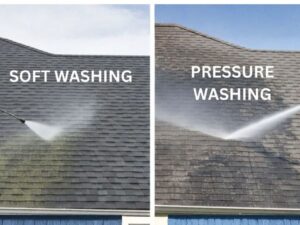
A sodium hypochlorite (bleach-based) or oxidizing cleaner kills the organism at the source. Applied at the correct concentration with adequate dwell time before rinsing, it addresses the biological contamination rather than just the appearance. This is the same chemistry professional soft washing uses on siding and roofing, applied here to concrete instead.
Full-strength bleach will not damage concrete structurally, but using it at unnecessary strength is wasteful and can affect nearby landscaping if not properly diluted and rinsed.
Tannin and Leaf Stains
Dark, irregular stains left behind after leaves or organic debris sit on wet concrete are tannin stains, caused by the plant’s natural pigments leaching into the surface. These are often mistaken for mold because of the dark color, but they are a different chemistry entirely.
Tannin stains typically respond to an oxidizing cleaner (the same peroxide or oxygen-based products used for organic growth) rather than an acid or degreaser. They also tend to fade with sun exposure over time even without treatment, though a proper cleaning speeds this up significantly.
Tire Marks
Tire marks are a combination of rubber residue and light petroleum compounds from the tire compound itself. They respond to degreasers similarly to oil, though the rubber component sometimes requires additional mechanical agitation (a stiff brush or a rotary surface cleaner) to fully lift.
Everyday Dirt and Grime
Not every discoloration on concrete is a distinct stain. General soiling from foot traffic, airborne dust, and pollen usually responds to a pH-neutral all-purpose concrete cleaner combined with pressure washing. In the Upstate specifically, spring pollen builds up in a thick layer that can look like a stain but is really just an accumulated coating; a straightforward wash typically clears it without any specialty chemistry. This is the one category where a generic product genuinely performs well, because there is no specific chemical bond to break.
Product Categories at a Glance
| Stain Type | Chemistry Needed | Notes |
|---|---|---|
| Everyday dirt/grime | pH-neutral general cleaner | Pressure washing alone often sufficient |
| Fresh oil | Absorbent + degreaser | Act quickly for best results |
| Set oil/grease | Alkaline or enzymatic degreaser | Older stains may need repeated treatment |
| Rust | Acid-based (oxalic acid) | Bleach and degreasers do not work |
| Red clay | Buffered acid formulated for iron oxide | Do not rely on pressure alone; can worsen the stain |
| Efflorescence | Mild acidic mineral-deposit cleaner or water + brushing | Bleach and oxalic acid do not address it |
| Mold/algae/mildew | Sodium hypochlorite or oxidizer | Kills the organism, not just the visible layer |
| Tannin/leaf stains | Oxidizing cleaner | Fades naturally over time as well |
| Tire marks | Degreaser + mechanical agitation | Rotary surface cleaner helps |
Concrete Condition Changes the Approach
Not all concrete should be treated the same way regardless of the stain.
New concrete (under 60 days) is still curing. Acidic cleaners can react unpredictably and cause discoloration during this window, so wait until curing is complete.
Sealed concrete resists staining, but the seal can also block cleaning products from reaching a stain that occurred before sealing or through a crack. Some cleaners are incompatible with certain sealer types and cause cloudiness or peeling.
Decorative and stamped concrete often has color additives that aggressive acid cleaners can strip or lighten unevenly. Spot-test first.
Painted concrete (garage floors and porches finished with a concrete or epoxy paint) should never be treated with acid-based cleaners, which etch bare concrete and will instead lift or dull the paint film. Heavy staining on painted surfaces sometimes means the coating needs to be stripped and reapplied rather than chemically treated.
Exposed aggregate and older, more porous concrete trap contaminants more readily and generally need longer dwell times or stronger chemistry to fully treat.
Pressure Washing vs. Chemistry: Why More PSI Is Not the Answer
This is where most DIY concrete cleaning goes wrong, and it applies across every stain type above.
Pressure washing is genuinely effective for removing loose material: dirt sitting on the surface, dust, cobwebs, and light surface grime. Water at 2,000 to 4,000 PSI physically dislodges what is not chemically bonded to the concrete.
Pressure washing is far less effective for anything that has absorbed into the pores. Oil, rust, red clay, and the root structures of biological growth are not sitting on top of the concrete; they are embedded within it. No amount of force removes a chemical bond. In some cases, as with red clay, high pressure can actively push the contaminant deeper.
What professionals do differently is sequence, not just equipment. A proper process follows this order: pre-treatment with chemistry matched to the specific stain, adequate dwell time for that chemistry to break the bond, then pressure washing (usually with a rotary surface cleaner for even coverage) to physically remove what the chemistry has already loosened. Skipping pre-treatment and going straight to high pressure is why rental pressure washer results often disappoint despite a powerful machine.
Higher PSI does not compensate for the wrong chemistry. A 4,000 PSI machine used on an untreated rust stain will not remove rust, because rust removal is a chemical problem, not a force problem.
DIY vs. Professional Cleaning
DIY concrete cleaning is reasonable for small areas, light staining, and everyday grime, particularly with products designed for the specific stain type. Professional cleaning becomes the more practical choice in several situations:
Large driveways and commercial concrete where covering the area evenly with correct dwell times is difficult to execute consistently by hand.
Deep or old oil and rust stains that may require professional-grade concentrations and repeated, precisely timed treatments.
Red clay staining, since plain pressure washing can worsen the problem, and the buffered acid chemistry needed requires careful handling.
Heavy organic growth, since improperly diluted bleach can damage landscaping while under-diluted solutions fail to kill growth at the root.
Multiple stain types on the same surface, which requires sequencing different chemistries correctly.
Sensitive surrounding areas, including established landscaping or pools where runoff needs careful management.
At Eco Blast, our professional concrete cleaning process identifies the stain type first, applies the matched pre-treatment chemistry, and finishes with commercial-grade surface cleaning equipment that produces even results without the streaking a handheld wand leaves behind.
Frequently Asked Questions
What is the best all-purpose concrete cleaner?
There is no single best cleaner for every stain, since oil, rust, red clay, and biological growth each require different chemistry. A pH-neutral general cleaner works well for everyday dirt and grime, but stain-specific problems need stain-specific products.
What removes oil stains from concrete?
Fresh oil responds to absorbent materials followed by a degreaser. Older, set stains need an alkaline or enzymatic degreaser with adequate dwell time, sometimes requiring multiple applications.
Does bleach clean concrete?
Bleach kills organic growth like mold and algae but does nothing for oil, rust, red clay, or efflorescence, which each require different chemistry.
What removes rust from concrete?
An acid-based treatment. Oxalic acid is the most common option for homeowner use, applied diluted with a dwell period before scrubbing and rinsing. Degreasers and bleach do not affect rust.
How do you remove red clay stains from concrete?
Red clay contains iron oxide that bonds chemically into concrete pores. A buffered acid formulated for iron oxide is needed to break that bond before rinsing. Pressure washing alone often fails and can push the staining deeper.
What is that white chalky stain on my concrete or retaining wall?
Almost certainly efflorescence, a mineral deposit left when water carries dissolved salts to the surface and evaporates. It is neither mold nor rust, so bleach and rust removers will not touch it. If it keeps returning quickly, a moisture source is likely worth investigating.
Can pressure washing remove every concrete stain?
No. It removes loose surface material effectively but does not address stains chemically bonded into the pores, such as rust, red clay, and set oil. Chemistry breaks the bond first; pressure then rinses away what has loosened.
Is professional concrete cleaning worth it?
For light, everyday grime, DIY is often sufficient. For deep-set oil, rust, red clay, or heavy organic growth, professional cleaning is generally more effective because it applies stain-matched chemistry with correct dwell times rather than relying on pressure alone.
Match the Cleaner to the Stain, Not the Other Way Around
The fastest way to waste a weekend on concrete cleaning is buying one product and expecting it to handle everything on your driveway. Identify what you are actually looking at first: petroleum, metal oxidation, mineral deposits, or biological growth. Then choose chemistry built for that specific problem.
If your concrete has multiple stain types, heavy red clay staining, or has resisted DIY treatment, professional concrete cleaning applies the correct sequence of chemistry and equipment to get it right the first time. Contact Eco Blast or call 864-310-3916 for a free quote.
By Joshua Kelley, Founder & Owner, Eco Blast Pressure Washing