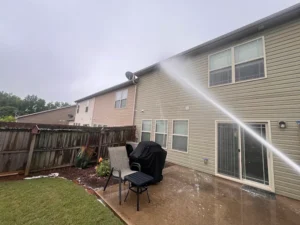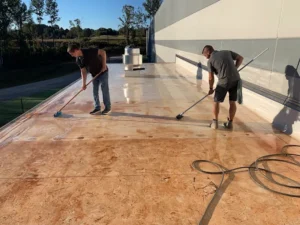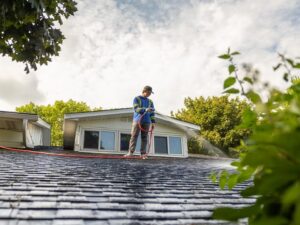
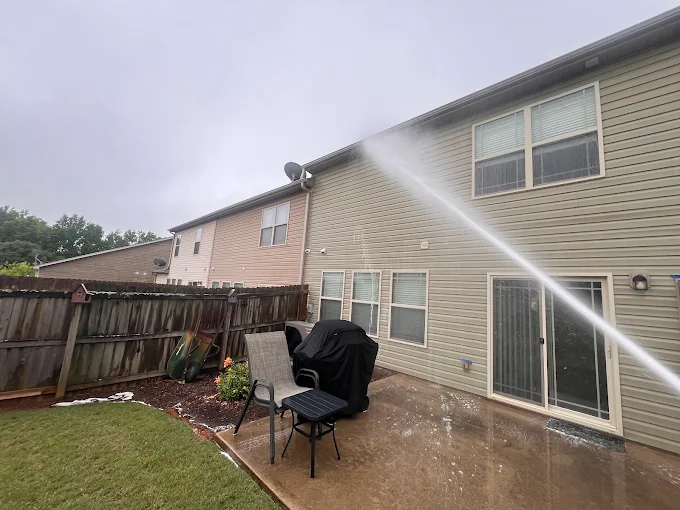
Search “how to power wash a house” and nearly every result gives you the same answer: use 1,300 to 1,600 PSI with a 40-degree nozzle.
That advice is incomplete in a way that causes damage. PSI is only one of three variables that determine how much force actually hits your siding. Distance and nozzle angle matter just as much, and a homeowner running 1,300 PSI through a 15-degree nozzle held six inches from the wall is applying far more destructive force than someone running 2,500 PSI through a 40-degree tip at three feet.
More importantly, pressure is not what cleans a house. Chemistry is. The algae, mold, and mildew growing on your siding are living organisms, and no amount of water force kills them. It knocks off the visible layer and leaves the root structure intact, which is why pressure-washed siding often looks green again within months.
This guide covers what actually cleans siding safely, how damage happens, what changes by material, and where the line sits between reasonable DIY and work that should be handed to a professional.
Pressure Washing vs. Soft Washing
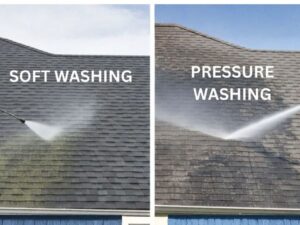
Pressure washing removes contaminants through mechanical force. High-pressure water physically blasts dirt off a surface. This works well on concrete, masonry, and other hard, dense materials that can absorb the impact.
Soft washing removes contaminants through chemistry. A cleaning solution is applied at low pressure, typically under 500 PSI, roughly the force of a garden hose. The solution kills algae, mold, and mildew at the cellular level, breaks the bond between the growth and the surface, and lifts embedded dirt so a gentle rinse carries everything away.
For house siding, soft washing is the correct method. Not the gentler alternative, the correct one. Professional exterior cleaning companies soft wash houses because it produces better results with zero risk of water intrusion, and because killing the organism means it takes far longer to return.
The distinction matters for your expectations too. A soft wash may look less dramatic during the job because there is no visible blasting. The results show up in what the surface looks like a year later.
Why Pressure Alone Fails on Organic Growth
The green film on a shaded wall is algae. The dark spotting under eaves is usually mold or mildew. These are living colonies with root structures that extend into the surface texture of your siding.
High-pressure water removes what you can see. The roots remain. Within a few months in a humid climate, the colony regenerates from what was left behind, and the homeowner concludes their siding “gets dirty fast.”
A cleaning solution containing sodium hypochlorite kills the organism completely. That is why professionally soft-washed siding stays clean substantially longer than pressure-washed siding, and it is why professional companies can offer guarantees on the work. Our professional house washing services carry a 1-Year Algae-Free Guarantee, which would be financially reckless to offer if we were only removing surface growth.
Oxidation Is Not Organic Growth
This distinction trips up more homeowners than any other, and almost no article covers it.
Organic growth appears as green, dark gray, or black patches and streaks. It concentrates on shaded elevations, under eaves, behind shrubs, and on north-facing walls. It is alive and it spreads. Cleaning solution kills it.
Oxidation appears as a faded, chalky, hazy white film. It concentrates on sun-exposed elevations, typically south and west facing. It is not alive. It is the UV-driven breakdown of the vinyl or paint surface itself, and it develops over years of sun exposure.
Here is why this matters: if you rub a faded section of siding with your hand and a chalky white residue transfers to your palm, that is oxidation. No amount of pressure or cleaning solution will restore it, because the surface material itself has degraded. Attempting to “clean harder” on oxidized siding often makes the appearance worse by removing the residue unevenly and creating blotching.
Heavy oxidation requires either a specialty restoration product or repainting. A cleaning company that promises to remove severe oxidation with a standard wash is either inexperienced or setting you up for disappointment. Light oxidation often improves noticeably with a proper soft wash, but severe chalking will not.
How Siding Damage Actually Happens
Water intrusion behind panels. Vinyl siding hangs on the wall and interlocks. It is designed to shed water running downward. Spraying upward, especially at close range, drives water up behind the panels and into the wall cavity where it soaks house wrap and insulation. This causes mold growth inside the wall that the homeowner will not discover for months or years. This is the single most damaging DIY mistake, and it happens even at “safe” PSI levels when the angle is wrong.
Cracking and warping. Vinyl becomes brittle with age and in cold temperatures. Concentrated pressure on aged siding can crack panels or dislodge the locking tabs holding them to the wall.
Paint stripping. Painted surfaces have finite bond strength. Pressure sufficient to remove dirt is often sufficient to lift paint, especially where the coating has already begun failing.
Surface etching. On wood and some composites, high-pressure water erodes surface fibers, leaving a raised, fuzzy texture that holds dirt worse than the original finish.
Window and seal damage. Direct pressure on window seals, frames, and glazing can breach the seal and allow water into the assembly. Vents, fixtures, and outlet covers are similarly vulnerable.
Landscape damage. Solution runoff without proper pre-soaking and post-rinsing can damage or kill established plants.
What Changes by Siding Material
There is no universal setting. What is safe on one material damages another.
Vinyl siding is the most forgiving of the delicate materials, but the most prone to water intrusion because of how it hangs and interlocks. Always spray downward or straight on, never upward.
Fiber cement (HardiePlank) is physically tougher than vinyl but the painted factory finish is not. Pressure can dull or strip the coating and chip edges. Manufacturer guidance generally recommends low-pressure washing with a garden hose or soft brush.
Painted wood siding requires the most care. Pressure lifts paint and etches the grain. Wood also absorbs water, and driving moisture into the substrate causes swelling and accelerates paint failure.
Stucco and EIFS are extremely vulnerable. High pressure destroys the textured finish, and on EIFS it can breach the moisture barrier behind the surface. That repair costs thousands.
Brick and masonry appear durable but mortar joints are not. High pressure erodes mortar and pits the brick face, creating texture that traps dirt permanently. Brick is porous and holds growth deeper, so it needs chemistry with dwell time rather than force.
Understanding Pressure, Distance, and Nozzle Together
If you are going to use a pressure washer on siding, understand that these three variables work together. Changing one changes the effective force at the surface.
Nozzle angle determines how the water disperses. A 40-degree nozzle (white) spreads water across a wide fan, reducing force per square inch at the surface. A 25-degree nozzle (green) concentrates it more. A 15-degree (yellow) or 0-degree (red) nozzle should never come near siding under any circumstances.
Distance matters more than most homeowners realize. Force drops significantly as distance increases. The same nozzle at 18 inches delivers dramatically more impact than at 36 inches.
PSI is the machine’s rating, not the force reaching your wall. A 2,500 PSI machine with a 40-degree tip at three feet is gentler on siding than a 1,400 PSI machine with a 25-degree tip at one foot.
The practical rule: if you can see the water visibly disturbing or rattling the siding, you are too close or the nozzle is too concentrated. Back off until the spray is clearly diffused when it contacts the surface.
The Chemistry Does the Work
Professional house washing uses cleaning solution as the primary cleaning agent and water as the delivery and rinse mechanism. That is the entire concept behind soft washing.
For homeowners, the practical version is: apply a house wash detergent designed for siding, let it dwell for the manufacturer’s recommended time (usually several minutes, and never let it dry on the surface), then rinse at low pressure.
On bleach: sodium hypochlorite is what professional soft wash solutions use, but concentration and application matter enormously. Too strong damages siding, kills landscaping, and discolors surfaces. Too weak fails to kill the growth. Professional solutions also include surfactants that help the mixture cling to vertical surfaces and rinse cleanly, which household bleach does not have.
Running undiluted bleach through a consumer pressure washer’s detergent tank will also damage the pump seals. If using a chlorine-based cleaner, apply it separately with a pump sprayer at appropriate dilution, and pre-soak all landscaping thoroughly.
A Safe DIY Process
If your home is single-story, your siding is in good condition, and you are comfortable with the work, here is a reasonable approach.
Inspect first. Walk the perimeter. Look for cracked or loose panels, failing caulk, peeling paint, and gaps at penetrations. Cleaning makes existing problems worse.
Identify what you are dealing with. Green or dark patches on shaded walls are organic growth and will respond to cleaning solution. Chalky white haze on sunny walls is oxidation and will not.
Protect the property. Close windows and doors. Cover outlets and fixtures. Move furniture away. Thoroughly soak all landscaping with plain water before applying anything.
Apply solution from the bottom up. This prevents streaking. Work in sections so the solution does not dry before rinsing.
Let it dwell. The solution needs time to kill growth and break bonds. Do not let it dry on the surface.
Rinse from the top down. Wide nozzle, comfortable distance, spraying downward or straight on. Never spray upward into siding seams.
Rinse landscaping again immediately after each section.
Inspect the result while you still have equipment set up.
Mistakes That Cause the Most Damage
Spraying upward into siding seams. The most common and most expensive mistake. Drives water into the wall cavity.
Using a narrow nozzle. The zero-degree and 15-degree tips have no legitimate use on any siding material.
Working too close. Distance is the easiest variable to control and the one most often ignored.
Letting solution dry on the surface. Causes streaking and can etch or discolor siding.
Skipping the landscape pre-soak. Plant damage from runoff is entirely preventable.
Cleaning oxidized siding aggressively. Makes the appearance worse, not better.
Ignoring the manufacturer’s warranty terms. Some siding warranties specify cleaning methods. Improper washing can void coverage.
Working from a ladder while operating a pressure washer. The wand produces kickback. Managing that force at height is genuinely dangerous.
When to Hire a Professional
DIY house washing is reasonable on a single-story home with sound siding and light organic growth. Several conditions change that calculation.
Two-story or taller homes. Reaching upper elevations means working from a ladder while managing wand recoil, or using extension equipment most homeowners do not own. Professional soft wash systems apply solution from the ground.
Heavy or established growth. Thick algae and mold require correct solution concentration and dwell time. Under-treating leaves roots that regenerate quickly.
Delicate materials. Stucco, EIFS, older painted wood, and aged brittle vinyl carry damage risk that outweighs the cost savings.
Existing siding problems. Failing caulk, loose panels, or damaged areas make water intrusion likely.
Extensive landscaping. Significant foundation plantings need protection protocols that are easy to underestimate.
In the humid Upstate South Carolina climate, where algae and mold stay biologically active nearly year-round and shaded elevations rarely dry out completely, most homes need annual attention. Soft washing that actually kills the growth is what makes that interval hold.
Frequently Asked Questions
What PSI is safe for vinyl siding?
Under 1,500 PSI with a 40-degree nozzle at 24 inches or more is a commonly cited safe range, but PSI alone is misleading. Distance and nozzle angle change the effective force at the surface as much as the machine rating does. Professional soft washing uses under 500 PSI and relies on cleaning solution instead of force.
Can pressure washing force water behind my siding?
Yes, and it is the most damaging DIY mistake. Vinyl siding interlocks to shed water downward. Spraying upward, especially at close range, drives water up behind panels into the wall cavity, soaking house wrap and insulation. This causes mold inside the wall that may go undetected for years. Always spray downward or straight on.
Is soft washing better than pressure washing for house siding?
For siding, yes. Pressure removes visible growth but leaves the root structure, so algae returns quickly. Soft washing uses a cleaning solution that kills the organism at the cellular level, which produces longer-lasting results with no risk of water intrusion or surface damage.
Can I use bleach to clean my siding?
Sodium hypochlorite is what professional soft wash solutions use, but concentration and application matter. Household bleach lacks the surfactants that help solution cling and rinse properly, and running it through a pressure washer’s detergent tank damages pump seals. If using a chlorine cleaner, apply separately at proper dilution and soak all landscaping before and after.
Can pressure washing damage fiber cement or HardiePlank siding?
Yes. Fiber cement is physically durable but the painted factory finish is not. Pressure can dull or strip the coating and chip board edges. Manufacturer guidance generally recommends low-pressure washing with a garden hose or soft brush. Soft washing is the appropriate professional method.
Why does my siding get dirty again so quickly after washing?
Usually because the cleaning removed visible growth without killing it. Algae and mold have root structures that survive pressure washing and regenerate. In humid climates this can happen within months. Soft washing with a proper solution kills the organism, which is why it stays clean substantially longer.
How do I clean the second story of my house safely?
Ideally, you do not do it from a ladder. Pressure washer wands produce kickback that is difficult to manage at height, and ladder falls are a leading cause of home injury. Extension wands allow ground-level work on some homes, but for most two-story properties professional service with ground-applied soft wash systems is the safer option.
How often should I wash my house?
In humid climates like the Southeast, annually is the baseline. Homes with heavy shade, mature tree cover, or persistent north-facing dampness may need attention every 8 to 10 months. Properties in drier regions or with full sun exposure may go 18 to 24 months.
Pressure does not clean a house. Chemistry does. The safest and most effective approach to siding is a cleaning solution applied at low pressure, given time to work, then rinsed gently downward.
If you are working on a single-story home with sound siding and light growth, a careful DIY approach with a wide nozzle, generous distance, and proper landscape protection is reasonable. If you are dealing with a two-story home, heavy growth, delicate materials, or existing siding issues, the risk calculus shifts.
If you want a professional assessment of what your siding actually needs, contact Eco Blast or call 864-310-3916. We serve homeowners throughout Upstate South Carolina.