
Maintaining gutters at home means checking the complete rainwater path, not merely removing visible leaves. A dependable routine includes inspecting the gutter channels, clearing debris, confirming that each outlet and downspout flows, and checking where the water discharges. Most Greenville-area homeowners should plan spring and fall inspections, then adjust for tree cover, roof design, past overflow, gutter guards, and major storms.
Gutters, downspouts, and outlets work together to convey roof runoff to a controlled location. Their maintenance includes removing accumulated debris and checking for storm damage or structural problems.
The quick answer: a practical gutter maintenance routine
Use this four-part routine:
- Inspect from the ground. Look for debris, sagging, gaps, stains, plant growth, loose extensions, and pooling.
- Watch the system during rain. From a safe location, note where water spills over, runs behind the gutter, or fails to leave a downspout.
- Clean and test the complete path. The gutter channel, outlet, downspout elbows, vertical pipe, and extension must all remain open.
- Record recurring problems. Overflow that returns after cleaning may indicate incorrect pitch, loose hangers, failed seams, damaged fascia, inadequate capacity, or a buried drainage problem.
Treat gutter maintenance as a recurring system rather than a once-a-year chore. The correct frequency is the one that keeps water moving before debris becomes compacted.
What does gutter maintenance actually include?
The open gutter channel catches roof runoff. Water enters an outlet, passes through downspout elbows and the vertical pipe, then exits through an extension, splash block, surface outlet, or underground drain.
A complete routine includes:
- Removing leaves, pine needles, twigs, seed material, roof grit, and sludge
- Keeping outlets and downspouts open
- Confirming that water reaches a known discharge point
- Looking for standing water, sagging, separated seams, loose brackets, and end-cap leaks
- Checking above-ground extensions and gutter guards
- Recording defects that require a gutter, roofing, fascia, or drainage professional
Downspouts should send water to an appropriate location rather than concentrating it beside the foundation. Complicated or recurring stormwater problems may require help from a drainage, landscaping, or engineering professional.
Cleaning inside a gutter is different from washing stains from its exterior face. It is also different from roof cleaning. A clean-looking gutter face does not prove the channel or downspout is open.
The fascia is the generally vertical board behind the gutter. The soffit is the underside of the roof overhang. Cleaning cannot repair damaged material in either area.
How often should you inspect and clean your gutters?
Use spring and fall as a baseline, then inspect more often when the property has greater debris exposure or a history of poor drainage. A fixed “twice a year” rule does not fit every home.
| Property condition | Practical plan |
|---|---|
| Minimal tree cover, simple roof, no prior overflow | Inspect in spring and after fall leaf drop, plus after severe weather. Clean when debris reaches an outlet or slows flow. |
| Moderate tree cover or several roof sections | Inspect at the start of each season. Plan a spring cleaning and another after most autumn leaves fall. |
| Heavy pine cover, nearby branches, fine debris, or roof valleys | Inspect more often during active shedding, potentially monthly at peak times, and after strong storms. |
| Gutter guards | Check the surface each season and after storms. Follow the manufacturer’s instructions and investigate changed water entry or flow. |
| Previous overflow or an underground connection | Observe the next suitable rain after service and monitor closely until the repeat problem is identified. |
| Two-story home, complex roofline, steep terrain, or power lines | Perform ground-level checks and use a qualified professional for access, cleaning, and testing. |
Roof valleys deserve attention because they concentrate runoff and debris into a smaller gutter area. Fine material can cover an outlet even while most of the channel looks open.
A seasonal gutter maintenance schedule for Greenville and Upstate South Carolina
The National Weather Service’s Greenville-Spartanburg office maintains local precipitation records, climate information, and seasonal severe-weather climatology for the Upstate. A useful maintenance schedule should therefore combine planned seasonal checks with additional inspections after significant weather.
Late winter
Walk around the home after periods of wind or winter weather. Look for branches, shifted extensions, loose guard panels, visible gaps, and sections that no longer form a straight line.
Spring
Inspect before warm-season rain exposes a hidden blockage. Remove accumulated organic material and roof grit, confirm downspout flow, and check mulch or soil beneath outlets for fresh washout.
Summer storm season
Do not work during rain, lightning, high winds, or on wet surfaces. Once conditions are safe, check from the ground for storm debris, displaced extensions, dents, sagging, and new overflow marks. Observe performance during a later, ordinary rainfall.
Late summer and autumn
Pines may shed their older needles during late summer or early autumn, and most pine species experience natural needle drop during fall. Deciduous leaf fall can also continue for several weeks. One early cleaning may not cover the entire season. Time the final autumn service after the main debris drop, but clear an outlet sooner if water is backing up.
Early winter
Complete a final flow check after late-falling debris settles. Look for standing water, leaking seams, or extensions that discharge beside the house, then set the next inspection date.
How to inspect gutters safely from the ground
Inspect in daylight when the ground and exterior are dry. Walk the perimeter and use phone zoom or binoculars instead of climbing. Check:
- Whether the gutter line is straight or sagging
- Gaps between the gutter and fascia
- Debris, plant growth, or matted material on guards
- Water stains below one section
- Disconnected, crushed, or missing extensions
- Soil erosion, washed mulch, or pooling at discharge points
During safe, ordinary rainfall, observe from a protected ground-level position. Note water spilling at one point, sheeting across a guard, running behind the gutter, or leaving one downspout weakly while another flows strongly. A dry downspout beneath an overflowing gutter may have a blocked outlet, elbow, or pipe.
Never inspect outside during lightning, damaging wind, or hazardous rainfall.
What is the safest way to clean and test gutter flow?
Ground-level inspection is appropriate for most homeowners. Direct cleaning should be considered only when the home is low, access is straightforward, the ground is firm and level, suitable equipment is available, and the person can maintain safe control.
When a ladder is required, inspect it, follow its labels, maintain three points of contact, remain centered, and climb down to reposition instead of leaning sideways. Never stand on prohibited top rungs or place a ladder on an improvised base. OSHA also advises using ladders only on stable, level surfaces and not standing on the top three rungs of a straight or extension ladder.
Check for overhead electrical lines before moving or setting a ladder. The Consumer Product Safety Commission specifically identifies gutter cleaning as an activity that can bring ladders near overhead wires and warns that wind, uneven ground, or sideways reaching can cause contact.
Two-story homes, complicated rooflines, unstable ground, difficult access, and homes near power lines are better left to professionals.
Do not:
- Walk on a wet or steep roof
- Lean against the gutter
- Use a pressure washer from a ladder or on roof shingles
- Mix cleaning chemicals or pour harsh products into a downspout
- Force debris into a buried pipe when its route and outlet are unknown
- Work around nests, sharp metal, loose gutters, or damaged fascia
For an above-ground downspout with a visible exit, a controlled water test can confirm flow. Stop if water backs up or the discharge cannot be verified.
A downspout entering an underground line does not prove the buried drain is clear. Surface gutter cleaning and underground drain clearing are separate jobs.
How to prevent recurring gutter clogs
Track trouble spots. Record whether buildup repeatedly forms below a roof valley, beneath a branch, around an outlet, or under one guard section.
Manage vegetation safely. Have a qualified tree professional evaluate branches over or touching the roof. Do not trim from a ladder or climb onto the roof.
Keep outlets visible. A mostly clean channel can still overflow when a small mat of needles or sludge covers the outlet.
Maintain guards by design. Screens, perforated covers, and micro-mesh products handle debris differently. Leaves can sit on top, and fine material can settle near low points. Guards reduce debris entry; they do not make gutters maintenance-free. Gutter-guard manufacturer guidance also recommends occasional maintenance, post-storm inspections, surface debris removal, and checks for sagging or detached sections.
Confirm the discharge route. Reconnect loose extensions and observe where water goes. A clear gutter can still cause concentrated runoff when the extension has shifted, the outlet empties into a low spot, or a buried drain is blocked. Redirecting downspouts toward suitable landscaped or stormwater-management areas can be appropriate, but the location and drainage conditions must be evaluated first.
What do common gutter symptoms mean?
| What you observe | Possible cause | Best next action |
|---|---|---|
| Overflow at one location | Local debris, blocked outlet, or low spot | Clear and test. If it returns when clean, request a pitch or repair evaluation. |
| Overflow along much of a run | Blocked downspout, restricted guard, poor pitch, concentrated valley runoff, or inadequate capacity | Check the outlet and downspout first. Seek an evaluation if the clean system overflows in ordinary rain. |
| Water behind the gutter | Separation, loose hangers, or a roof-edge, drip-edge, or flashing issue | Do not assume cleaning will fix it. Arrange a gutter or roofing inspection. |
| Dripping seam or end cap | Failed joint or seal | Repair is normally required. |
| Sagging section | Heavy debris, loose hangers, distorted gutter, or damaged fascia | Avoid loading it and have the support assessed. |
| Downspout stays dry during rain | Blocked outlet, elbow, or pipe, or water bypassing the gutter | Trace the flow and test the downspout when safe. |
| Pooling or erosion near the outlet | Loose or short extension, poor discharge location, grading issue, or buried-drain blockage | Correct an obvious connection if safe; use a drainage professional for recurring or buried problems. |
| Dark streaks on the gutter face | Exterior runoff staining or oxidation, separate from an internal clog | Check flow first, then use an appropriate exterior-cleaning method. |
| Plants growing from the gutter | Long-standing wet organic debris | Arrange complete cleaning and check for standing water or damage. |
One symptom can have several causes. Ask not only whether debris is present, but whether the system collects, carries, and discharges water correctly.
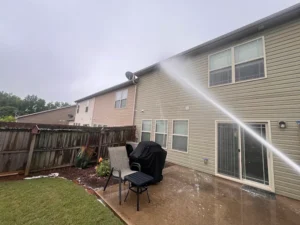
Overflow marks or organic staining on siding are a separate exterior-cleaning issue. Eco Blast’s professional house washing service includes soffits, fascia, and downspouts, while gutter-face oxidation or tiger striping is listed as an add-on. Exterior washing does not replace clearing the gutter or correcting the reason it overflowed.
When is cleaning no longer enough?
Cleaning can remove leaves, needles, grit, sludge, and straightforward outlet or downspout clogs. It cannot correct:
- Incorrect pitch or persistent low spots
- Loose hangers, separated seams, or leaking end caps
- Damaged fascia
- Crushed or disconnected downspouts
- Poor discharge locations or grading
- Blocked underground drains
- An undersized gutter or downspout system
- Roof-edge or flashing defects
If ordinary rainfall produces the same symptom after the channel and downspout are open, move from repeated cleaning to a repair, roofing, or drainage evaluation.
Keep a simple gutter maintenance log
| Record | What to note |
|---|---|
| Inspection date | Routine, seasonal, or post-storm check |
| Weather | Dry inspection, recent storm, or observed rain |
| Debris | Leaves, needles, twigs, grit, sludge, or guard buildup |
| Overflow | Exact location and whether water went over the front or behind |
| Downspouts | Which outlets flowed and where they discharged |
| Repairs | Seam, hanger, fascia, pitch, roof-edge, or drainage concern |
| Photos | File name or phone album |
| Next inspection | Date based on debris level and season |
The log’s value is showing whether the same corner, outlet, or discharge point fails repeatedly.
When should you schedule professional gutter cleaning?
Professional help is sensible when safe access is uncertain, the home has multiple stories, guards are difficult to remove, downspouts repeatedly block, or overflow continues after visible debris is gone.
Eco Blast’s verified service includes hand-clearing debris, flushing downspouts, inspecting the system, bagging and hauling removed material, and alerting homeowners to bracket, seam, sagging, or fascia concerns. Eco Blast does not advertise gutter repair or installation, so structural or underground drainage work may require another specialist.
Homeowners who need a complete cleaning and flow check can review Eco Blast’s professional gutter and downspout cleaning. The company serves Greenville and other Upstate communities.
Maintain the water path, not just the visible gutter
A useful maintenance plan is property-specific. Inspect from the ground, observe the system during safe rainfall, clear debris before it blocks an outlet, verify each downspout and discharge point, and document repeat symptoms.
When a clean system still sags, leaks, holds water, or overflows, treat it as a repair or drainage question rather than scheduling the same cleaning again.
For difficult access, recurring blockages, or a complete gutter and downspout service, contact Eco Blast at 864-310-3916 or request a gutter-cleaning estimate online.
Frequently Asked Questions
How often should gutters be cleaned in Greenville, SC?
Inspect gutters in spring and after the main autumn debris drop, then adjust the schedule for the property. Homes with pine needles, dense tree cover, roof valleys, guards, previous overflow, or underground downspout connections may need more frequent checks. Cleaning should occur before debris covers an outlet or slows downspout flow, not only on a fixed calendar.
How can I tell whether a downspout is clogged?
Watch the system during safe, ordinary rainfall. A gutter that fills near one outlet, weak or absent flow at the downspout exit, water leaking from an elbow, or backup during a controlled flow test can indicate a blockage. The clog may be at the gutter outlet, an elbow, the vertical pipe, or an underground connection, so identify the discharge route before forcing anything through it.
Do gutter guards still need maintenance?
Yes. Gutter guards can reduce the amount of larger debris entering the channel, but leaves and needles may collect on top while fine material settles near outlets or underneath the cover. Inspect the guard surface seasonally and after strong storms, follow the product manufacturer’s instructions, and investigate any place where water sheets over the edge instead of entering the gutter.
Can clean gutters still overflow?
Yes. A clean channel may overflow because the downspout is blocked, the gutter has an incorrect pitch or low spot, a guard restricts water entry, a roof valley concentrates runoff, or the system lacks enough capacity for the flow reaching it. If an open channel and downspout still overflow during ordinary rain, request a gutter or roof-drainage evaluation rather than repeating the same cleaning.
Is standing water in a gutter normal?
A small amount of residual moisture immediately after rain is different from a visible pool that remains in one section. Persistent standing water can indicate an incorrect pitch, a sagging run, or an obstruction near the outlet. Remove debris and recheck the section. If water remains when the channel and outlet are open, the gutter likely needs adjustment or repair.
Why is water running behind my gutter?
Water behind a gutter can result from a gutter pulling away from the fascia, loose hangers, or a roof-edge, drip-edge, or flashing problem that allows runoff to bypass the channel. A clog can worsen the symptom, but cleaning alone may not correct it. Have the gutter attachment and roof edge inspected before deterioration spreads to the fascia or soffit.
Can I inspect gutters without getting on the roof?
Yes. Most routine monitoring can be done from the ground with phone zoom or binoculars. Look for debris, plants, sagging, gaps, stains, displaced extensions, and pooling. Then observe the system from a sheltered ground-level location during safe rainfall. If confirming the problem requires roof access or a high ladder, use a qualified professional rather than taking that risk.
Should I inspect gutters after every major storm?
A brief ground-level check after significant wind or heavy rain is useful, especially on homes beneath mature trees or with a history of overflow. Wait until lightning, wind, and other hazards have passed. Look for fallen branches, shifted guards, loose extensions, new sagging, erosion, and fresh stain lines. A full cleaning is necessary only when the inspection shows debris or restricted flow.